Growth Equity Gets Its Own Sector – and Performs Better

Venture capital and private equity research group Cambridge Associates has declared growth equity as a distinct asset class, with distinct differences in investment strategy, asset quality and return profile warranting its recognition alongside the two other long-established alternative investment classes. In its most recent market commentary the research firm argues that the growth equity market is distinguished from the venture and private equity markets not only by its investment style and targets, but by its returns. The firm’s analysis of 260 U.S. growth equity investments made between 1992 and 2008 shows growth equity investments besting venture returns in three, five and ten year holding periods, and equaling or exceeding private equity returns after three and five year holds. “It outperformed venture capital over the crucial 10-year window by nearly six points,” the firm notes. Growth equity investments likewise outperformed the Russell 3000 in all but one year of the 17-year research period.

Demand for Emerging Growth Issuers Fuels IPO Run

Initial public offerings are on track to have their best year in a decade as investors display an appetite for riskier bets in emerging growth companies (EGCs). Issuers raised $30.7 billion in 131 IPOs through Aug. 9 this year, according to research firm Dealogic. Over the same period in 2012, only 97 issuers had completed IPOs, although they had raised $32.2 billion in capital. Some of the dollar volume discrepancy could hinge on the market participation of EGCs, which have completed 82% of the IPOs this year and have raised about half of the total proceeds, according to Dealogic.

APO Redux: New Solicitation Rules Open the Door for Direct Public Offerings

No sooner had the ink begun to dry on the SEC’s recently adopted amendment to Rule 506 of Regulation D allowing the public promotion of equity private placements, and free-thinking securities attorneys and investment bankers began pondering the possibilities of their new-found freedom to hawk their wares from the mountaintops. Ever the innovators never willing to accept the well-trodden path when a cleverly engineered shortcut is available, in no time the cleverest among them began to imagine what was only recently regarded as unthinkable: the rebirth of the APO market. APOs, or “alternative public offerings,” are generally referred to a combination of a public shell company with a private operating business that is concurrent with an equity private placement by the public company, which results in a capitalized public company which owns the private operating business. APOs first became popular in the middle of the past decade, when a perfect financial storm of greed, demand and opportunity came together. The greed came from the surfeit of PIPE deal makers – fund managers, placement agents and deal attorneys – that had grown around the PIPE market during its heyday of 2000-2006, when a public offerings market in disarray and a whole generation of newly public internet companies in financial chaos combined to bring PIPEs issuers into the market by the bushel, offering fat discounts to investors who could lock in their returns with a quick call to their options broker.

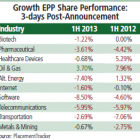
Energy Exploration, Medical Device Growth EPP Issuers Buck Post-Deal Price Drops in Q2

The stock market’s bull run in the first half of 2013 that pushed the Dow Jones Industrial Average and Standard & Poor’s 500 indexes to all time highs failed to influence initial investor reaction to growth equity private placements (EPPs). Looking at stock price performance on an industry-by-industry basis, investors largely sold on the news of a private deal, and sentiment three days after announcement was frequently more pessimistic than the response over the first half of 2013, according to analysis by Growth Capital Investor. Additionally, transaction activity slowed from a year earlier while the average dollar amount fell, according to data provided by PlacementTracker, a division of Sagient Research. Growth EPPs are offerings of a least $1 million of stock or equity-linked debt that feature fixed purchase, conversion and warrant exercise price terms, and that are sold by companies that have market capitalizations from $10 million to $1 billion as well as a share price of at least $1 at closing. The three-day post-announcement stock performance data examined excluded rights offerings, at-the-market offerings and structured equity lines.