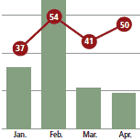
Emerging Growth Capital Rebounds in Q1

Investment activity in U.S.-listed emerging growth companies via equity private placements surged 77% in the first quarter, while the average size of new placements rose 24% to more than $5.5 million, an impressive rebound from the final quarter of 2011. Even more impressive was the flood of money into growth-oriented “unstructured” equity private placements (EPPs) in emerging growth companies by long-term fundamental investors, which rose 268% over the previous quarter to $5.88 billion, representing 73% of all capital invested via equity-linked private offerings in U.S. public companies.1

The flow of growth-oriented private placement capital into emerging growth companies2 has eclipsed traditional “structured” private placement (i.e. “financial PIPE”) activity in the EPP market in terms of the percentage of deals and dollars for the second straight quarter, as growth capital investors embrace EPPs as an efficient vehicle to acquire and nurture positions in up-and-coming public companies. Unstructured equity private placements, unlike their financially-engineered structured cousins that once dominated the EPP market, are aligned with common shareholder interests and contain no variable conversion prices, resets, pre-sold equity line puts, or offsetting hedges that disengage structured investors’ returns from those of common shareholders. Fueling this trend are venture capital, private equity and other “long-only” and long-term growth-focused investors, which have embraced the EPP market and are providing leadership in identifying and nurturing high-growth companies during their earliest stages of post-private life. These “sponsored” growth capital EPPs, which include at least one fundamental investor that is primarily a venture capital, private equity, mutual fund, family office or corporate strategic investor, accounted for 31 deals comprising $3.81 billion in capital in the first quarter, with the median placement valued at more than $15 million.

Growth Companies Enter the Spotlight

Advocates for the reform of small growth company finance regulations have been demanding better treatment for years. The emphasis on job creation in a presidential election year tarred with an unemployment rate above 8% may provide that opportunity. At the least, the new JOBS Act and other actions geared toward improving the lot of small issuers should bring more attention to the group’s role in creating JOBS and fostering innovation. At the most, the measures could ignite a capital-raising frenzy. Despite the sunnier outlook, a host of challenges remain.

Facebook Fame Heralds Pre-IPO Share Frauds

Publicity around transactions in private shares of hot pre-IPO companies like Facebook have transformed the secondary market for such shares from an obscure bazaar to a well known venue whose huge potential for rewards can also draw fraudsters. The Securities and Exchange Commission recently took action against two operations that allegedly used the lure of private share investments to fleece unwary investors. A spokesman for the commission would not comment on the specific situations but noted that theSECissued a pre-IPO scam alert in March and updated it on April 24. “SECstaff is aware of a number of complaints and inquiries about these types of frauds, which may be promoted on social media and internet sites, by telephone, email, in person, or by other means,” according to the alert. “In another matter in September 2010,” the alert says, “a judgment order was entered in favor of the SECbased on allegations that a scam artist had misappropriated more than $3.7 million from 45 investors in four states by offering fake pre-IPO shares of companies, including AOL/Time Warner, Inc., Google, Inc., and Rosetta Stone, Inc. before the companies went public.”

Nick Bhargava, CEO and co-founder of Motaavi, said in an email that “Facebook has made the pre-IPO private company markets highly visible.” (Motaavi was established to facilitate equity crowdfunding and provide a market for trading shares issued to crowdfunding investors once theSECfinishes regulations for this form of financing.)

“Before Facebook, the average person did not know that stock in such companies could trade hands many times before the IPO,” Bhargava said.

SEC Sanctions Attorneys over Bogus Opinions

The Securities and Exchange Commission recently took action against three attorneys who allegedly wrote improper opinions in support of securities issuances. In three separate matters, the commission filed suit against Florida resident Cameron Linton, sanctioned Texas attorney and former SEC counsel Phillip Offill, Jr., for evading registration requirements, and found that Boca Raton, Fla.-based William Reilly violated a previous order banning him from practicing before theSEC. Legal opinions are required for the sale of restricted securities held by insiders or investors who otherwise purchased shares that cannot be sold immediately. Regulators are always on the lookout for mercenary attorneys willing to write opinions that allow illegal sales to take place and avoid regulatory scrutiny in order to manipulate prices. Offill was imprisoned after a jury concluded in early 2010 that he had played a role in a variety of pump and dump schemes, including several related to PIPE financings of reverse merger companies.