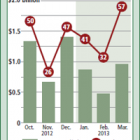
Growth Equity Offerings Increase in Q1

Growth companies raising capital in equity private placements during the first quarter continued to benefit from an investment trend that is focused on fundamentals, one that is supplanting a market once dominated by funds bent on arbitrage and structured investments. While first quarter capital-raising activity usually slows in relation to traditionally busy fourth quarters, the confluence of Hurricane Sandy, the presidential election and fiscal cliff uncertainties late last year managed to upend the norm. Issuances of 102 growth equity private placements (EPPs) in the first three months of 2013 exceeded 2012’s fourth period total by 11 deals, according to PlacementTracker, Sagient Research’s research tool that tracks equity private placements of more than $1 million. Deal activity in the first quarter this year was on par with the period a year earlier, when companies completed 105 growth EPP transactions. (Growth EPPs are defined here as private placements of a least $1 million of stock or equity-linked debt that feature fixed purchase, conversion and warrant exercise price terms, issued by public emerging growth companies with market capitalizations of between $10 million and $1 billion and a common share price of $1 or more at the time of the deal’s close.


SEC Clears a Path for a Viable Equity Capital Marketplace with Second No-Action Letter on Angel Crowdfunding

When the SEC followed up its March 29 “No-Action” letter to an online angel investment platform with a second letter a day later addressing the same issue to a different online angel funding startup, it did something that no-action letters aren’t supposed to do: it made policy. And by successively offering to stand-down from enforcement of the onerous broker-dealer rules governing most equity offerings, it cleared a path, albeit rock-strewn and circuitous, toward a viable crowdsourced equity market – something that the agency has been unable or unwilling to do within the mandates of the JOBS Act. The message delivered by the agency in those letters to the FundersClub and AngelList online angel funding websites was that small but not insignificant amounts of investment capital may be aggregated together through online networks and restricted equity securities distributed in return, without registering as a broker-dealer or as a JOBS Act “crowdfunding portal,” FINRA’s soon-to-be Cinderella stepchild. William Carleton, an attorney that has watched the JOBS Act implementation closely and regularly writes about it at Crowdsourcing.org and his own blog, calls the publication of the two letters “momentus.” While cautioning that no-action letters only establish a “green zone” within which certain activities are allowed given specific conditions and contexts, he still nonetheless believes they were meant to sketch out a framework for exempted crowd fund-raising and investment. “[I]t is fair to say that no-action letters are rarely, if ever, as high profile as these two,” Carleton wrote.

VC

Sponsors Step Back from Market in Q1

Sponsored growth equity private placements - deals backed by long term investors such as venture capital, private equity, corporations, endowments, pension and mutual funds, generated significant deal flow in the first quarter of 2013, but at rates well below the same period a year ago. In the first quarter such investors included pharma buyout specialist Frost Group, energy investor Natural Gas Partners, storied tech VC Kleiner Perkins, multi-stage VC firm Oak Investment Partners, long-biased hedge fund Aspire Capital, business development company Hercules Technology Growth Capital (HTGC), the Janus and Legg Mason mutual funds, and China sovereign fund CITIC Capital. A quick look at the numbers suggests that sponsored private placements in the first quarter represented a much smaller portion of the overall PIPEs market than they did in the first quarter of 2012, but the limits of disclosed data make a direct comparison problematic. In the first quarter of 2012, some $3.3 billion from 66 sponsored PIPEs accounted for 24% of the deal activity and 48% of total PIPE volume as 278 deals brought in total capital of $6.8 billion. In the first quarter of 2013, A total of 26 sponsored deals raised only $480 million, representing just 10% of the deal activity and  less than 7% of the capital raised in the broader EPP market of 252 offerings that raised $7.23 billion.

Epstein_The Perfect Corporate Board

Negotiating with Hedge Funds: 5 Ways to Save Time, Money, & Dilution


Join us for a Growth Capital Investor webinar for capital markets teams of emerging growth companies seeking to level the field in finance negotiations with investors. Featuring an in-depth discussion of common mistakes made by issuer teams by Adam Epstein of Third Creek Advisors and Joe Smith of Ellenoff Grossman & Schole. April 25, 2013   2:00 - 3:30 pm EST
Complimentary for subscribers, $99 per site for others. Click here for details and to register.        Sponsored by