William Blair Fund Invests in Nanosphere

William Blair’s $5 million investment in Nanosphere (NSPH) provides another illustration of growth capital fund activity in the equity private placement market, where Nanosphere sold stock in a registered direct offering as part of a $27 million debt and equity financing. Craig-Hallum Capital Group was the sole bookrunner for the underwritten transaction, and William Blair Small Cap Growth Fund was the investor. Craig-Hallum has served as agent for 62 EPPs that raised $1 billion since 1999. The transaction closed on May 8. The Blair fund joins earlier investors in Nanosphere including Frontier Capital Management, TFS Capital Cortina Asset Management, Granahan Investment Management, and Bain Capital Venture Investors.

Broken PIPEs

As Balance Returns to Growth EPP Market, Traditional Unregistered PIPE Banks MIA

Five years ago, in the hey-day of the hedge fund-dominated PIPE market, micro- and small-cap market placement agents competed furiously for equity private placement (EPP) business wherever they could find it. While they might be stronger in one sector over others, none of the active banking firms shied from deals in unfamiliar industries – they were seen as growth opportunities. The same held true of issuance structures. Different banks had different strengths but few ever passed on a deal due to the issuer’s structural preferences, and most offered the full palette of structural options to issuers that could command them. The only significant structural specialization developed around equity lines of credit, and to a lesser extent, alternative public offerings (APOs).

Capital Demand Keeping BDCs in Capital-Raising, Deal-Making Mode

Business development companies are getting rock star treatment at the moment, soaking up the love from yield-hunting investors and small companies seeking capital for growth, recapitalizations and special situations like management buyouts. BDCs typically provide preferred equity and a variety of fixed and floating-rate debt, from mezzanine to senior secured first-lien loans, and often charge 10% to 20% for the capital. As regulated investment companies, BDCs are required to distribute at least 90% of their investment income to shareholders in dividends. Ten BDCs have completed IPOs since 2011, according to a recent report by law firm Sutherland Asbill & Brennan, and several are in registration. In late March, Goldman Sachs Group (GS) filed with the Securities and Exchange Commission to take a newly formed BDC public.

Old, New Players Drive April EPP Market

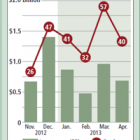
A recent flurry of growth equity deals highlights the mix of old and new investors that currently comprises the equity private placement (EPP) market. Relative newcomers Sabby Management and Aspire Capital Partners have invested in 16 deals (including structured equity lines) this year, five in the last two weeks in April. And while some many pioneers like Laurus Capital Management, NIR Group and Yorkville Advisors have left the market, old hands like Deerfield Management, Iroquois Capital and Downsview Capital continue to invest in private placements from a wide range of issuers. In the last two weeks of April, some 46 EPPs raised $984 million, including four ATM transactions which did not disclose proceeds. While common stock deals such as ATMs and CMPO have dominated the PIPE market, the recent flurry of deals included ten fixed-price convertible debt or convertible preferred offerings.