Corey Ribotsky

NIR Group’s Ribotsky Settles Fraud Charges with SEC

Beleaguered PIPE fund manager Corey Ribotsky has settled two-year old fraud charges leveled by the Securities and Exchange Commission, agreeing to pay more than $14 million in disgorged profits and penalties rather than continue to contest charges that as the general partner of NIR Group, he repeatedly lied to investors regarding the valuation of the fund’s microcap securities holdings, the fund’s returns, the liquidity of the fund, his education, and that he repeatedly misappropriated funds for his personal use. Under the terms of the November 18 agreement, Ribotsky did not admit, nor can he deny, the charges in the SEC’s complaint. During the more than five years since the SEC investigation was reported in the press, the Long Island, NY-based fund manager vociferously maintained his innocence and repeatedly attacked the journalists and their news organizations for reporting on the investigation, and the SEC’s investigators for pursuing it. In its hey-day NIR Group was one of the most prolific PIPE-dedicated hedge funds in the market, investing over $225 million in more than 140 microcap companies. The fund had a reputation for investing in some of the smallest, least liquid and most distressed companies in the PIPE market, with more than 80% of its investments placed in companies which market caps under $20 million.


Oppenheimer

Oppenheimer & Co. Forms Private Stock Secondary Markets Group, Hires Directors

Oppenheimer & Co. has hired Boaz Rahav as managing director to establish and lead the firm’s Private Shares Group. The new group will be exclusively focused on providing liquidity and new capital solutions for private companies and their shareholders, including venture capital firms and angel investors. Boaz has over 20 years of investment experience, portfolio management, and new product development. He was formerly the chief economist for the Government of Israel Ministry of Finance in New York.

crowdfunding

Crowdfunders Receive Blueprint

The Securities and Exchange Commission’s 585 pages of proposed rules for crowdfunding released last month amped up the chatter from online platforms, angel investors and third party service providers catering to entrepreneurs, startups and small growth companies. Crowdfunding supporters had waited more than 18 months for a hint of what the rules would entail after the JOBS Act legalized the funding-by-the-masses concept and directed the SEC to craft the regulatory oversight. The proposal, known as Regulation CF, is broadly focused on raise and investment limits related to the incomes of non-accredited investors. Reaction has been typical: The SEC did a good job crafting some rules, and poor job on others. Among the policies put forth, the commission revealed that it would allow companies to conduct separate offerings at the same time.

Registered EPPs Move Down Market

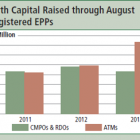
Registered equity private placements (EPPs) are becoming available to ever-smaller emerging growth companies, as a robust small cap market and increasing competition among placement agents for deal flow broadens the potential pool of eligible issuers. Registered EPPs, including registered direct offerings (RDOs), confidentially marketed public offerings (CMPOs) and at-the-market offerings (ATMs), are now being executed by the smallest of public companies, further diminishing the need for these companies to rely on expensive and highly dilutive PIPEs to fund their corporate development. More than $4.2 billion in growth capital has been raised in 200 registered EPPs so far this year through Nov. 1 by emerging growth companies with market caps from $10 million to $1 billion, according to data by PlacementTracker, the EPP tracking service of Sagient Research Systems. That’s a better than 10% increase in total deals closed at this time last year, when 182 offerings had been completed. Total capital raised or committed is also up compared to the year ago period, with $6.1 billion closed or committed compared to $5.9 billion a year ago.