
EDU

New Oriental Education Making a Comeback?

China-based shell merger company New Oriental Education & Technology Group (EDU) took an anvil ride in July, when a Muddy Waters report questioned many of the company's claims. The company's shares fell 35% when the report was released on July 18, but more recently positive news, including regulatory approval of consolidation accounting, has New Oriental on the uptick. Share prices moved up on Oct. 15, when New Oriental, which bills itself as the largest provider of private educational services in China, announced that Securities and Exchange Commission staff voiced no objection to the accounting behind merging some business units into the company's consolidated financial statements. The SEC's approval of accounting practices is, of course, hardly an endorsement of the company or its stock. But the news did bring on a flurry of trading after New Oriental shares opened at $19.34 on Oct.
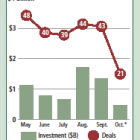
Q3 Growth Capital Formation Bucks Summer Lull

Emerging growth companies (EGCs) accelerated fund raising during a traditionally sleepy time for the capital markets this year, although market participants suggest that small cap issuers still must crest steep challenges to find cash – let alone “friendly” money in the private placement market. EGCs raised $3.2 billion in 105 growth equity private placement transactions (EPPs) in the third quarter, according to PlacementTracker, a service of Sagient Research. While activity and dollar volume decreased from the second quarter (145 EPPs; $3.8 billion), it still represented a significant improvement over the third quarter of 2011, when issuers raised $2.4 billion in 86 deals. (The growth capital EPP dataset includes issuers with a minimum stock price of $1 and market capitalizations of $10 million to $1 billion. It excludes equity lines, unknown structures, deals with floating and reset pricing, and at-the-market offerings.)

Companies issued 43 shelf offerings, making registered deals the most-used structure in the third quarter.

John Kirkland, Ironridge Global

A New Growth Equity Investor’s Solo Approach

Despite recording more deal and dollar volume in the third quarter versus last year, companies continue to face a tough financing climate, said John Kirkland, managing director with San Francisco-based investor Ironridge Global IV. Much of the difficulty stems from bad actors and toxic deals that have cast the PIPE market as “a rogues’ gallery,” he said. Subsequently, all investors get painted with a broad brush so that the “good tend to get weeded out with the bad,” he added. “It’s extremely hard for issuers to find money right now, and it’s only getting harder for investors to do deals,” he said. “The fact that (in September) we were at a fantastic conference (hosted by former placement agent powerhouse Rodman & Renshaw) at Rockefeller Center, and a week later they cease to exist, is indicative of the problems in the microcap space.

Broken PIPEs

Whither the PIPE Funds of Yesteryear?

A variety of factors has created new PIPE investing dynamics, and most of the high-volume investors from before the global financial crisis have left the space or curtailed their operations. As long-only mutual fund, pension, private equity and other broad spectrum investors like Fidelity Management & Research,Teachers Insurance and Annuity Association, T. Rowe Price Associates, and AQR Capital Management have become prominent purchasers of PIPEs and registered equity private placements (EPP) in both deal flow and dollars invested, many trading-oriented hedge fund investors have cut back their EPP investing drastically or moved on completely. While the trend doesn’t come as news to most professionals active in the emerging growth capital market, the magnitude of the shift may. Analysis comparing PlacementTracker transaction volume data for the first three quarters of 2012 and the comparable period in 2007 found that only five investors from the top 25 investors in 2007 made the same list this year: Heights Capital Management, Hudson Bay Capital Management, Downsview Capital, Iroquois Capital, and UBS O’Connor.