Emerging Growth Companies Lead IPO Market

Most of the JOBS Act provisions intended to facilitate capital formation are still in limbo nearly a year after the law passed and despite congressional pressure on the Securities and Exchange Commission to stop dragging its feet. But small issuers have aggressively taken advantage of the benefits available under the new Emerging Growth Company (EGC) category, a central piece of the law intended to grease the capital-formation skids for firms contemplating initial public offerings. Seventy-two EGCs raised $11.2 billion in IPOs in 2012, according to capital markets researcher Dealogic. That represented a substantial chunk of the IPO market last year: All told, issuers raised a total of $43 billion in 128 IPOs, according to Renaissance Capital Partners, a Greenwich, Conn.-based global IPO research and analysis firm. In early December, Ernst & Young reported that EGCs had filed 74% of new IPO registrations since the JOBS Act became law in April.

daVinci Capital Group

Growth Capitalist Profile: daVinci Capital Group

Growth Capital Investor’s editors sat down with Gary Post and Robert Winter of daVinci Capital Group, a newly-launched California-based growth equity investment firm  focused on fundamental investment in public emerging growth companies under $250 million in market cap. daVinci Capital stands at the vanguard of a new breed of emerging growth investor that is seeking to employ the equity private placement market to take significant, medium to long-term stakes in small, public, high-growth companies and help steer their development into profitable, liquid, and high-value small cap companies. GCI:  Describe the structure of your firm – are you a stand-alone fund, a fund-of-funds, feeder or seed fund, a sub-advisory, or something else? POST:   daVinci is structured as a fundamental private equity investor, not a hedge fund, to provide growth capital via minority equity private placements. We are looking primarily at emerging public companies, up to about $250 million in market value, but we can also provide expansion capital to private companies.

VC

Late Stage VC Rounds Start Year with Bang

While fiscal cliff fears and free-floating economic gloom dampened the final weeks of 2012, venture investors interested in up-and-coming companies have been busy in the first weeks of 2013. Companies that saw post-start-up VC investors coming back for more include Versartis, Streetline, Pontiflex, Panaya, LED Engin, Pure Storage, BuzzFeed and Aileron Therapeutics. Versartis, a Redwood City, Calif.-based growth hormone developer, closed a $25 million Series C round. The company is currently enrolling children for a study of VRS-317, a long-acting growth hormone for the treatment of pediatric growth hormone deficiency. Versartis is in clinical trials with both adult and pediatric versions of the hormone.

PIPE Deals Jan 2013

Growth Equity Investors Dominate 2012 PIPE Market League Tables

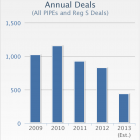
Fundamental investment-oriented growth equity investors increasingly replaced trading-oriented funds as leaders in the PIPE market in 2012, according to data released by market monitor PlacementTracker. For the first time since the data service began tracking investment in PIPEs in 1995, a long-only mutual fund manager led the annual PIPE investor league tables in total deals and total investment among active funds, usurping the fast-money hedge funds that had dominated not only the top spot but the entire top 25 rankings in many years. Fidelity Management & Research invested $190.7 million in 45 growth equity private placements in 2012, making the mutual fund behemoth the leading active investor in the market in both number of deals and total investment. But Fidelity was not alone among fundamental-oriented investors making their way up the PIPE ranking list last year. Of the top 25 investors in the market, at least 10 are generally regarded as long-only, fundamental-focused mutual and venture capital fund managers, including insurance and annuity giant TIAA, Wellington Management, Columbia Management, T. Rowe Price, and Orbimed Advisors.