Scorpio Deal Behind PIPEs March Madness

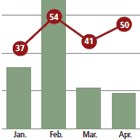
The second $200+ million PIPE issued by Scorpio Tankers (STNG) this quarter helped power the growth equity private placement (EPP) market to its biggest week of the year last week. Deals announced that week account for $413 million invested. (Figures are based on deal announcement dates and companies that meet our emerging growth company criteria including a $1 minimum share price and $1 billion maximum market cap.)

The next biggest week of the year was the last one in January, when an earlier $230 million Scorpio offering helped drive dollar volume to $359 million. The $413 million week consisted of growth EPPs issued in several sectors, most prominently industrial transportation. All the deals were common stock offerings, except for a $10 million non-convertible debt and preferred stock issuance from OCZ Technology (OCZ).

BDC

BDC Fundraising Efforts Lead to Private Placement Market

Business development companies that provide debt and equity to emerging growth companies have turned to the private placement, debt and follow-on markets to stuff their war chests and expand portfolios. As voracious users of capital, BDCs generally keep an eye peeled to opportunities to raise funds in favorable market windows. But the easing of credit markets and an appetite for yield over the past few years have amplified their ability to add leverage and attract cash, and mature BDCs with market capitalizations exceeding $1 billion as well as newer firms with lower valuations are milking the bullish environment. In the private placement market alone, BDCs raised more than $1.2 billion last year in 15 transactions, according to data from Sagient Research’s PlacementTracker database of equity private placement deals. In 2011, the issuers attracted more than $1.6 billion in 14 deals.

PhotoMedex Rises as Reverse Merger Phoenix

The reverse merger market is littered with the remains of companies that were ill-prepared to go public, but the 16-month old union of PhotoMedex (PHMD) and Radiancy tells a different story, a story of success for both parties to the reverse merger – at least so far. The merger between serial PIPE issuer PhotoMedex and Radiancy created a profitable business, which PhotoMedex had not been able to achieve on its own even after ten PIPE financings dating back to 1999, when the company was known as Laser Photonics. While reverse mergers often involve a shell with no operations, the 2011 reverse merger of PhotoMedex and Radiancy combined two active skin treatment companies. The survivor of the transaction markets products including PhotoMedex’s Xtrac laser treatment systems and Radiancy’s no!no! hair removal products. Prior to the merger, which closed in December 2011, PhotoMedex had been in business for well over a decade.

Increasing Demand for ATM Programs Revealing Agent, Issuer Differences

Public companies with share prices above $1 and market caps from $10 million to $1 billion established nearly 60 ATM programs in 2012 seeking to raise $3.3 billion, according to PlacementTracker data. That’s up from four agreements with a total registration of less than $350 million in 2008. “I think a lot of folks think that each year [ATM growth] is a blip and that things are going to return to the way they used to be, but that’s not what the data’s saying,” said Todd Wyche, founder and CEO of Brinson Patrick Securities. “The number of issuers using them, the amount of capital being raised and the number of investment banks participating is increasing, so I think it’s a tool that’s here to stay.”

But like an equity line, establishing an ATM isn’t a guarantee that growth issuers will receive a cash infusion, especially if they are illiquid or have a very small market cap. In fact, seven of the 34 growth issuers that signed up for an ATM program in 2011 have yet to raise any capital, according to PlacementTracker, which records at-the-market sales that are typically disclosed quarterly.