Growth Equity Market in Transition as Autumn Deal Season Begins

The emerging growth capital market rounds the corner into the fall deal season with overall robust deal flow masking major shifts in how and to whom capital is allocated. Increasing reliance on registered offerings of common stock priced at market is remaking the old PIPE market of “desperation financing” into a deep and efficient marketplace for issuers seeking strategic capital to fuel targeted corporate development programs.

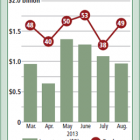
At the close of August, the equity private placement (EPP) market had raised $29.15 billion in capital in registered and unregistered equity and equity-linked offerings in 2013. That’s a 5% increase over the same period in 2012. That respectable aggregate market growth overlays significant shifts in capital allocation by growth capital investors away from unregistered to registered offerings, led by the growth of at-the-market (ATM) and, surprisingly, old-fashioned rights offerings. Were it not for a 300% increase in ATM dollars raised, and 400% increase in rights offerings in the first eight months of the year compared to a year ago, the 2013 EPP market would be trailing 2012 activity by almost $10 billion.  ATM offerings increased from 80 programs raising $765.8 million a year ago to 108 programs that have raised $2.38 million so far this year, accounting for 8% of all capital raised in the EPP and PIPE markets this year.


ATM

ATM Deals Grow While Registered Directs and CMPOs Stagnate

More than five years ago The Securities and Exchange Commission loosened rules on the ability of small growth companies to register shares on a shelf, triggering greater demand for registered direct deals. The financial crisis accelerated the trend as cautious investors sought to reduce the risk associated with restricted PIPE securities. Shifting strategies, hedge funds focused on buying instantly tradable registered shares, which later became available through overnight confidentially marketed public offerings (CMPOs). But use of the traditional registered direct vehicle and its newer CMPO variation has flattened over the last several quarters as companies have begun to increasingly gravitate toward at-the-market offerings (ATMs). The ATM structure, which also distributes registered shares from a shelf, generally provides a cheaper route to equity financing that’s frequently received more kindly by the market.

Tim Keating

Keating Debunks the Myth of the IPO Window

When investment bankers tell executives of emerging growth companies that the time is not right to go public because the IPO “window” is “closed,” they are saying more about their appetite and capacity to do the deal than they are about market conditions. That’s the conclusion drawn in a recent white paper released by Keating Investments’ president Tim Keating that analyzed IPO closing dates over the past 12 ½ years and found that IPOs are regularly closed during 41 out of 52 weeks of the year, or 79% of the time. The paper, “IPO Window: Open 79% of the Time,” is the latest in a series of essays Keating has penned in recent months challenging the conventional wisdom of the emerging growth capital markets, ranging from the lack of equity research for newly public companies to the supposed value a bulge-bracket investment bank brings to an initial offering. Keating analyzed 1,626 IPOs over 652 weeks from January 1, 2001 to June 30. In the average year at least one IPO was closed in 41 out of the 52 possible weeks.

Growth Equity Gets Its Own Sector – and Performs Better

Venture capital and private equity research group Cambridge Associates has declared growth equity as a distinct asset class, with distinct differences in investment strategy, asset quality and return profile warranting its recognition alongside the two other long-established alternative investment classes. In its most recent market commentary the research firm argues that the growth equity market is distinguished from the venture and private equity markets not only by its investment style and targets, but by its returns. The firm’s analysis of 260 U.S. growth equity investments made between 1992 and 2008 shows growth equity investments besting venture returns in three, five and ten year holding periods, and equaling or exceeding private equity returns after three and five year holds. “It outperformed venture capital over the crucial 10-year window by nearly six points,” the firm notes. Growth equity investments likewise outperformed the Russell 3000 in all but one year of the 17-year research period.