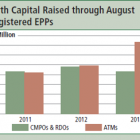
Registered EPPs Move Down Market

Registered equity private placements (EPPs) are becoming available to ever-smaller emerging growth companies, as a robust small cap market and increasing competition among placement agents for deal flow broadens the potential pool of eligible issuers. Registered EPPs, including registered direct offerings (RDOs), confidentially marketed public offerings (CMPOs) and at-the-market offerings (ATMs), are now being executed by the smallest of public companies, further diminishing the need for these companies to rely on expensive and highly dilutive PIPEs to fund their corporate development. More than $4.2 billion in growth capital has been raised in 200 registered EPPs so far this year through Nov. 1 by emerging growth companies with market caps from $10 million to $1 billion, according to data by PlacementTracker, the EPP tracking service of Sagient Research Systems. That’s a better than 10% increase in total deals closed at this time last year, when 182 offerings had been completed. Total capital raised or committed is also up compared to the year ago period, with $6.1 billion closed or committed compared to $5.9 billion a year ago.

SEC

Reg D Offerings, Online Deal Platforms Proliferate in Wake of Repeal of General Solicitation Ban

Barely a month has passed since the SEC’s repeal of the ban on advertising Reg D private placement offerings became effective, and private placement agents have seized upon the new freedom to use online platforms to tout their deals. The agency said last week that more than $1 billion have been raised in 214 solicited private placements since the ban was officially lifted on Sept. 23. In statements to reporters following his testimony before the Senate Banking Committee, the SEC’s director of the division of corporation finance Keith Higgins said that there had been 170 news offerings that used the general solicitation safe harbor under Rule 506(c) of Regulation D to raise capital since the new rule became effective. An additional 44 offering that were commenced prior to the new rule’s effective date converted to 506(c) deals after Sept.

Mark Cuban

Maverick Justice

Mark Cuban

If there are any lessons to be learned from this week’s not guilty verdict in the SEC vs. Mark Cuban insider trading case, it must be that it’s good to be king. Or at least a billionaire, a celebrity, and a Texan. Mark Cuban, brash dot-com billionaire, professional sports team owner, reality TV show celebrity, and sometime microcap company investor, was acquitted of insider trading charges in Dallas federal district court last week. The verdict was reached by a hometown jury which took three and a half hours to decide that taking a call from the CEO of a public company in which he was the largest single investor, to be told about an impending and unannounced private placement which would dilute his holdings and almost certainly lower the value of his investment, to which he did not dispute that he replied, “Now I’m screwed.

Rich Anslow

Anslow & Jaclin Calls It Quits

Anslow & Jaclin, the New Jersey law firm that was once one of the most active firms providing securities counsel to Chinese companies seeking to go public in the U.S. via reverse mergers, is dissolving after 20 years, according to partners Richard Anslow and Gregg Jaclin. The partners made announcement in private meetings with colleagues and clients attending the Rodman & Renshaw Global Investment Conference in New York from October 8-10. Each stressed the dissolution of the partnership was amicable and that both attorneys would remain active in securities practice for small cap companies. Anslow will be joining the New York-based firm Ellenoff, Grossman & Schole, while Jaclin is joining Lawrenceville, N.J.-based Szaferman, Lakind, Blumstein & Blader, effective October 1. In an interview, Rich Anslow said the decision to dissolve his partnership with Jaclin was a difficult one, but was necessitated by the precipitous decline in the Chinese reverse merger market.