
SEC

Virgin Islands Advisor Faces Fraud Charges in Microcap Finance Scheme Linked to Jason Galanis

Regulators initiated proceedings against investment advisor James Tagliaferri on Feb. 21, and he was soon arrested on criminal charges involving claims that he defrauded investors through several types of financial chicanery. Tagliaferri stands accused of manipulating his two TAG Virgin Island funds in a manner that was both detrimental to their investors and beneficial to him and an associate who was sanctioned in 2007 for engaging in an alleged scheme to inflate the revenues of Penthouse Inc.

The indictments seek the forfeiture of $4.3 million in fees paid directly by clients and another $3.35 in undisclosed compensation. Tagliaferri entered a not guilty plea to the criminal charges on Feb. 27 in a U.S. District Court in New York.

Increasing Demand for ATM Programs Revealing Agent, Issuer Differences

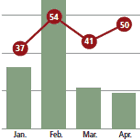
Public companies with share prices above $1 and market caps from $10 million to $1 billion established nearly 60 ATM programs in 2012 seeking to raise $3.3 billion, according to PlacementTracker data. That’s up from four agreements with a total registration of less than $350 million in 2008. “I think a lot of folks think that each year [ATM growth] is a blip and that things are going to return to the way they used to be, but that’s not what the data’s saying,” said Todd Wyche, founder and CEO of Brinson Patrick Securities. “The number of issuers using them, the amount of capital being raised and the number of investment banks participating is increasing, so I think it’s a tool that’s here to stay.”

But like an equity line, establishing an ATM isn’t a guarantee that growth issuers will receive a cash infusion, especially if they are illiquid or have a very small market cap. In fact, seven of the 34 growth issuers that signed up for an ATM program in 2011 have yet to raise any capital, according to PlacementTracker, which records at-the-market sales that are typically disclosed quarterly.

PUDA

Court Bars ‘Monty Python’ Defense for Puda Coal Directors

While a suit filed by regulators against Puda Coal (PUDA) management is going nowhere, a Delaware Judge refused to dismiss a shareholder action against independent directors who walked away after learning of wrongdoing at the company. "I'm not sure that the Monty Python response -- and I refer to the scene involving the words 'run away'" is adequate, Delaware Chancery Court Chancellor Leo Strine said in court earlier this month. Strine's reference derives from a scene in the movie "Monty Python and the Holy Grail" where knights flee a rabbit armed with impressive death-dealing powers. The situation holds few laughs for Puda Coal's directors or its shareholders. Puda went public through a reverse merger and subsequently raised over $120 million in PIPE transactions, ostensibly to fund operations of its PRC subsidiary Shanxi Puda Coal Group Co.

David Weiner W-Net

W-Net Fund Finds Few Worthy Reverse Merger Candidates

At a time when small companies find growth capital difficult to come by, W-Net Fund principal David Weiner says his company has trouble finding operating companies that are ready to go public via the reverse merger route. W-Net is focused on advising small and medium sized companies go public through reverse mergers. W-Net sometimes buys shells and invests in related PIPE transactions. W-Net recently announced a stake in internet marketing specialist ComF5 International (CMFV). The investor has also acquired stakes in hydroponics equipment maker GrowLife (PHOT), Digipath (DIGP), shell W270 (WSTY), privately held Medicus Research and PIPE issuer AtheroNova (AHRO). 

Weiner says W-Net is not a broadly investing hedge fund, but rather a vehicle to allow a few private investors to take a small number of positions in small private and public companies. While W-Net is not seeking to make numerous investments, it is having difficulty finding any qualified reverse merger candidates.